
Background
Sebastian Junger’s 1997 bestselling book The Perfect Storm recounts how the convergence of powerful storms in the North Atlantic sank the Andrea Gail – just a few hours after captain Billy Tyne, radioed area fishermen, “She’s coming on boys, and she’s coming on strong.”
Likewise, strong storms are threatening the nation’s electric grid. There’s the transition to EVs, heat pumps, electric stovetops, etc., and the ubiquity of computing devices – all increasing demand for electricity. And there’s the complication of integrating wind, solar and distributed energy resources into the grid. The “storms” are forcing utilities to make costly improvements to an already aging grid infrastructure – improvements largely paid for through demand charges billed to customers.
Demand charges, based on a customer’s single highest 15-minute energy spike of the billing cycle, can be 50-60% of a customer’s bill, up from 30% 5 years ago. The nature of EV charging is to pull a significant amount of energy in a short period of time, creating a demand spike in the process. Even if the DCFC is only once, this will cause a surprise increase in monthly utility bills.
Surprise bills are the new reality for NY area dealers, and technology strategies can help – especially battery storage:
Strategies to control costs – in order of increasing effectiveness:
- Analyze your bill using “interval data” – this enables analysis of usage patterns and spikes.
- Take advantage of utility sponsored smart charging programs
- Deploy cloud-based facility management software to provide performance monitoring, controls and alerts
- Install rooftop solar
- Integrate battery electric storage – prices are coming down, capabilities are going up. Battery Storage is the most powerful economic tool to control costs.
- Participate in utility demand load management programs, such NY’s Value of Distributed Energy Resources (VDER) and Demand Response, that compensates projects based on when and where they provide electricity to the grid.
Among these, the best strategy to avoid demand charges based on the use of DCFCs is to access energy stored in a battery. Installing battery storage does require permitting from the local government and interconnection by the local utility, but battery storage provides for more stable monthly bills and a degree of independence from the grid.
Optimizing any or all of the above strategies can be complex – and expensive. Installing cloud-based facility management software, rooftop solar, battery storage and system monitoring (aka, a “managed microgrid”) will cost a typical dealership about $1M. Costs can be reduced by approximately 50% after application of federal Investment Tax Credits, accelerated depreciation, utility make ready programs, and, depending on the dealership’s location, federal and NY incentive program grants. The
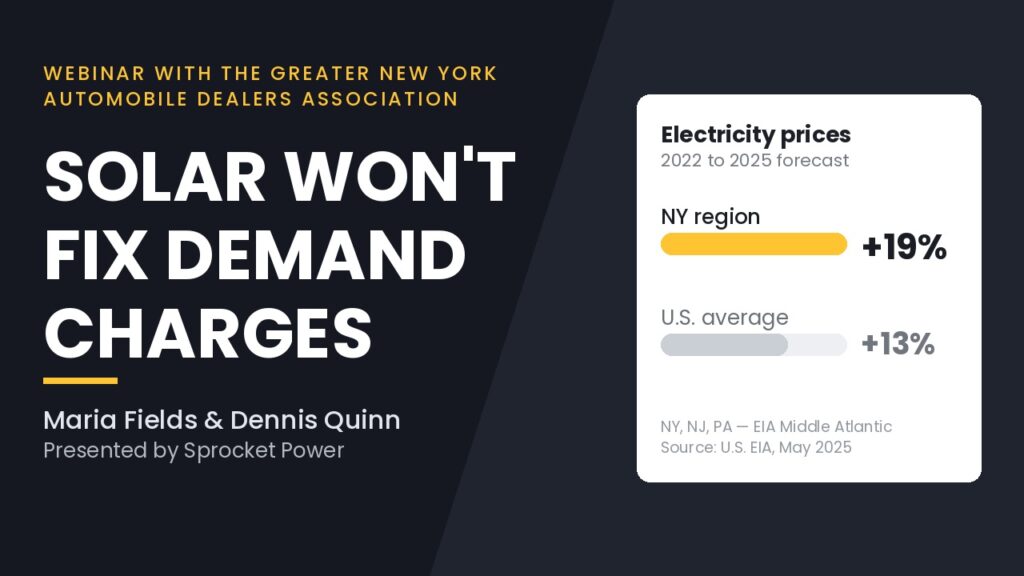
During a recent GNYADA webinar, Maria Fields, CEO, Sprocket Power, and William Acker, Executive Director, NY State Battery Energy Technology Consortium, discussed how best to minimize demand charges. The webinar, “Surprise Energy Bills in the Era of Electrification”, can be accessed by going to: https://www.gnyada-covid19.com/webinars-1/surprise-utility-bills-in-the-era-of-electrification