
Electricity Bill Shockers in an EV World
For those of you old enough to remember the 1968 movie “Planet of the Apes” (the script was co-written by Rod Serling of “Twilight Zone” fame), you’ll no doubt remember the closing scene when Colonel Taylor shockingly realizes he’s been on planet Earth all along, and not some distant planet far off in space.
That same sense of shock can hit franchised new car/truck dealers when they open their electric bill the first month after installing EV charging stations.

For any franchised dealer, installing EV charging stations is a given – after all, you have to be able to charge the EVs you’re selling and servicing. But unless you’ve planned to manage your electricity use after the introduction of EV chargers, you are in for a rude awakening when the utility bills start arriving.
But to plan, you first have to understand commercial utility billing. Bills for most commercial consumers of electricity are formulated based on the aggregation of two cost categories: Energy supply and demand delivery.
Energy supply is the amount of energy consumed (measured in Kilowatts per hour (kWh)) during the billing cycle. Figuring the cost of energy supplied is a relatively easy calculation: multiply the kWh used by the price of energy ($/kWh).
Demand delivery charges are based on your single highest 15 or 30-minute energy spike of the billing cycle (measured in kilowatts (kW) – intervals vary by utility). For most dealers, the introduction of onsite EV chargers, especially DC fast chargers, will cause that spike to increase dramatically. For example, if you install and use one 200kW fast charger during peak hours, your peak demand would increase by 200kW for the billing month. With fixed utility demand delivery charges of $30 per kW per month (the average in NY Metro utility territory), this could amount to an extra $6,000 charge per billing cycle.
And, if you have multiple EV chargers, the demand delivery spike grows and your demand delivery charges grow with it. If you have put your EV chargers on a separate meter, the difficulty in managing your costs increases.
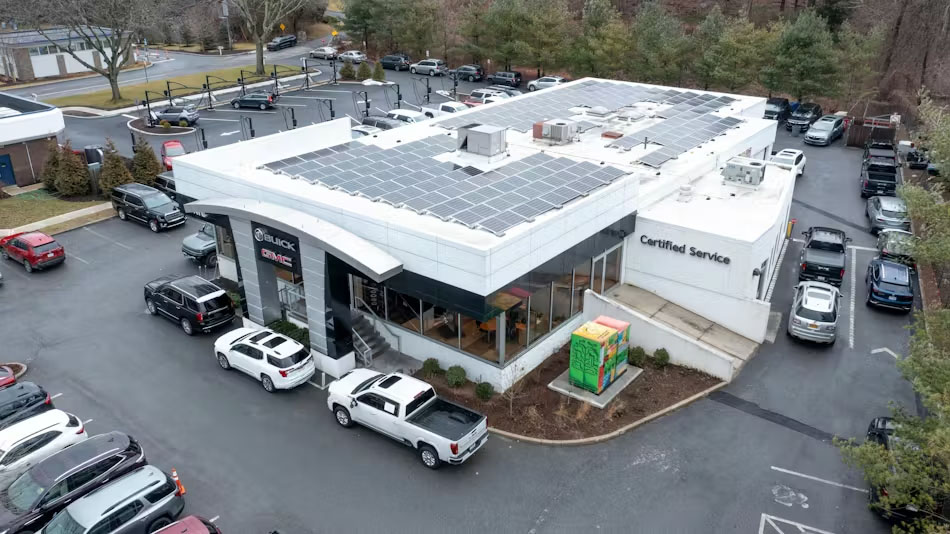
Unlike Colonel Taylor, who was confronted with a fate he couldn’t alter, dealership owners facing spiking demand charges have the ability to control their electricity use and reduce their utility costs by incorporating charge management software and installing an onsite managed microgrid. A managed microgrid integrates energy generation (solar), battery storage, and total facility management software to control every aspect of energy use at your facility. The result reduces energy use, directly targets demand spikes, and earns credits from NYSERDA’s “Value Stack”. For most dealerships in the NY Metro area, the result is a 50-80% reduction in net utility bills, an impact that flows directly to the bottom line.
Sprocket Power specializes in engineering and delivering facility upgrades to commercial businesses that integrate an onsite managed microgrid. To learn how Sprocket Power can help you install a managed microgrid at your facility to reduce your energy costs, contact Maria Fields at (914) 646-4016, mfields@sprocketpower.com, Ben Kriegler at (917)363-0606, bkriegler@sprocketpower.com, or Thomas Higgins at (518) 339-2193, thiggins@sprocketpower.com.