The auto industry sent a clear and undeniable message at the NY International Auto Show that an all-electric line-up of vehicles is the future, and Sprocket Power was there to engage with NY metro area dealers to provide insight on the benefits of an integrated EV charging strategy – for both auto dealers and the NY State energy grid.
Sprocket Power co-founder Maria Fields participated in the “Fast Track to EVs” panel held at the Javits Center during the Auto Show’s Industry Day. Maria spoke frankly about the challenges dealers face to meet OEM mandates for chargers needed to qualify for EV inventory. (Link to video here)
Maria described how those challenges include the high cost of adding EV chargers to facility infrastructure, upgrading facility utility service, and managing utility demand charges as EV chargers become operational. Maria also outlined the strong investment case that is attracting NY dealers to incorporate microgrid technology at their facilities, turning these multiple challenges into an opportunity.
EV Chargers
EV chargers are expensive pieces of equipment. Direct Current (DC) fast chargers, capable of charging a vehicle’s battery in roughly 30 minutes, cost up to $80,000 each. Typical OEM requirements demand that dealerships install several DC chargers along with several smaller level 2 chargers. The cost for just chargers alone can total between $100,000 to $400,000 dollars.
Obviously, this is a significant purchase. Evaluating hardware and software options is complex and requires technical expertise.
Upfront Costs and Electrical upgrades
Installing EV chargers requires significant electrical upgrades. DC fast chargers require electric service at higher voltage than what is typically supplied to commercial buildings by their utility, so dealers need to work with their utility to upgrade and increase the capacity of their service to the dealership.
These electrical service upgrades are a big part of the investment dealerships are making at a cost that is often more than the chargers themselves.
Operating Costs: Managing Demand Charges
The costliest component of a customer’s utility bill is the demand charge, which can approach 50% of a customer’s bill. And because EV chargers, especially DC Fast Chargers, require short bursts of electricity to provide electric vehicles with a fast charge, they add significantly to demand charges. These are recurring costs that, if not managed properly and at the start, can overwhelm a dealership.
The Good News – Investments in technology can turn these challenges into opportunities:
When it comes to the ongoing operational expenses of EV charging, technologies are available to manage these costs.
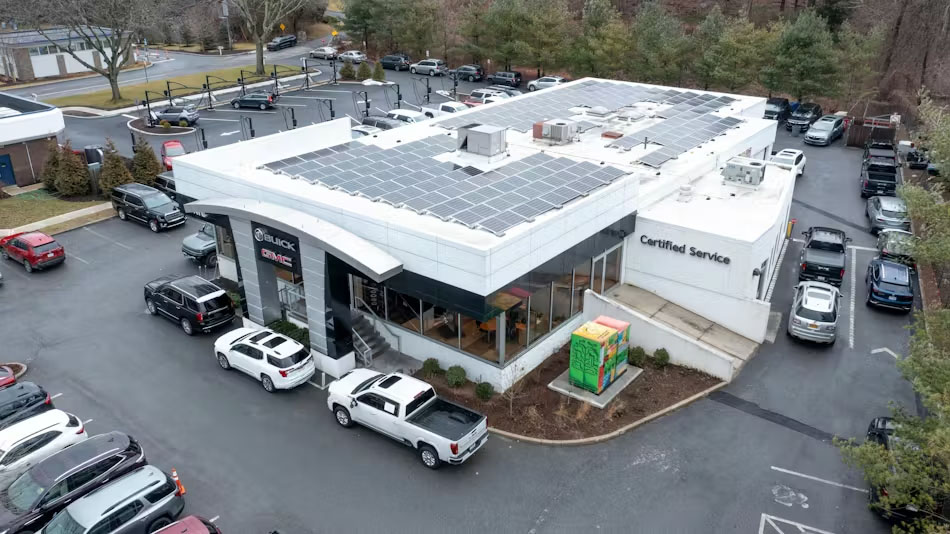
Maria explained how Sprocket Power helps dealers prepare to meet the expectations of their OEMs and their customers by employing the latest technology and strategic thinking to control demand charges and operating expenses through their connected microgrid approach. Sprocket Power engineers and delivers a facility upgrade that integrates the optimal combination of solar, energy storage, EV charging management, facility controls, and complete energy management – putting auto dealerships in a stronger position going forward.
Several programs bring significant financial support for these investments:
- The Federal Inflation Reduction Act and accelerated depreciation benefits can offset roughly 50% of upfront expenses through a direct reduction in federal tax obligation.
- Utilities have make-ready programs that help offset installation costs and electrical upgrades associated with EV charging – up to 90% for publicly available chargers.
- NY State’s Value of Distributed Energy Resources, or the VDER Value Stack, directly compensates businesses for energy generation and control that alleviates grid constraints. This puts dealers in the position to offset (or largely eliminate) their utility bill with earned credits.
The result is often an attractive investment that many NY dealers are now taking advantage of.
To learn how Sprocket Power can help you thrive (not just survive) in the EV revolution, contact Dennis Quinn at (503) 333-5474, dquinn@sprocketpower.com or Maria Fields at (914) 646-4016, mfields@sprocketpower.com.