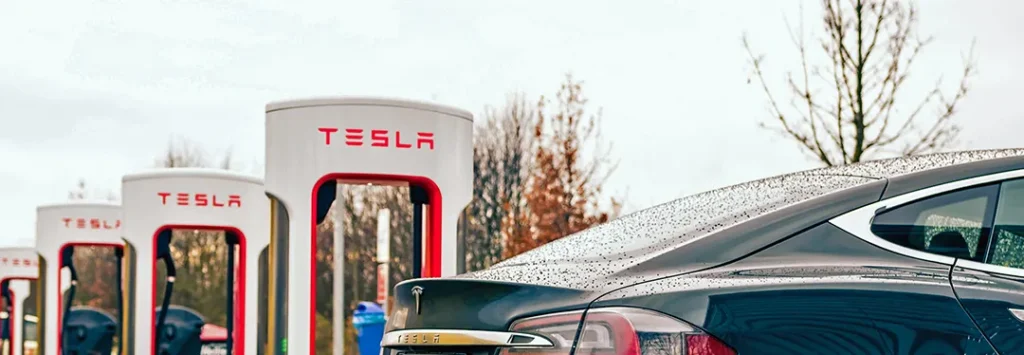
OEMs Align with Tesla for Access to Its Fast-Charging Network
Life is full of “First World” technology annoyances. Airpods often get lost. Power cord ends don’t fit the device in hand and streaming device remotes seemingly have legs.
Oh, and if you own an EV, you can add vehicle charging to the list of 21st-century irritations.
A 2022 study by Cool Earth, a California non-profit focused on climate change, found that only 72% of public chargers (Tesla Superchargers were not surveyed because they currently only serve Tesla cars) in the San Francisco area were operational. The chargers that weren’t working were experiencing connectivity issues, broken plugs, unresponsive screens, and payment system failures.
The consensus view is that Cool Earth’s findings are consistent with customer experiences across the country. What is also universally acknowledged is that OEMs can’t hit EV sales targets unless the charging experience improves dramatically.
In a couple of unexpected moves during the past several weeks, OEMs have banded together to solve this problem. First, Ford, GM, Rivan, Volvo, Mercedes, Nissan, and Polestar (and potentially Stellantis and Hyundai/Kia) announced deals with Tesla to adopt its North American Charging Standard (NACS) so their EVs can use Tesla’s charging stations. Then, seven automakers (BMW, GM, Stellantis, Mercedes, Honda, Hyundai, and Kia) announced a joint venture to install at least 30,000 EV chargers across the U.S. and Canada.
The Current Charging Network In North America Is Fragmented
Over the past decade, as Tesla was ramping up vehicle production, expanding its network of fast chargers, and acquiring huge chunks of market share, other OEMs and electrical equipment manufacturers were developing standards for a separate charging system for use with their EVs.
Tesla employs proprietary software and hardware design, which they are now calling the North American Charging Standard (NACS), that is inaccessible to owners of non-Tesla EVs. Meanwhile, other charging systems, which North American OEMs were designing, use the public domain Combined Charging System (CCS) plug standard.
Ironically, although non-Tesla owners cannot charge up at Tesla’s NACS chargers, Tesla owners can use a CCS adapter and charge their vehicles from a CCS charger. The net effect is that Tesla owners can access all 19,500 Tesla fast chargers in North America, plus the 11,500 or so CCS fast chargers scattered about the continent. Non-Tesla owners aren’t so lucky. It’s only the CCS chargers for them, and as noted above, the CCS fast chargers that non-Tesla owners must use are often not working.
Can’t Beat ‘em, Join ‘em
No doubt OEMs would have preferred to grow market share in a straightforward competition with Tesla. But the reality of the situation – Tesla sells 60% of the EVs sold in the U.S. and owns 70% of the fast chargers – required a strategy adjustment.
The companies understood that offering a stable of attractive EVs to a growing number of interested buyers wouldn’t be enough. They needed to remove the concern potential customers harbored over the unreliability of the charging network they’d be using.
A) Partnerships With Tesla
The OEMs’ partnership with Tesla enables their EVs to use Tesla’s charging stations with an adapter. That means their EVs that are on the road right now will be able to use Tesla’s fast chargers right away. And, starting in 2025, their EVs will be manufactured using Tesla’s NACS tech standard, meaning those vehicles won’t require the adapter.
B) OEM Consortium
The joint venture will take advantage of public investment, e.g., the Inflation Reduction Act (IRA), as well as private funds, to increase the number of charging stations throughout North America. The charging stations will be designed to offer both Tesla’s NACS and CCS plugs. Additionally, the consortium is hoping that power to the stations will be supplied from renewable energy sources.
What’s In It For Tesla?
It seems somewhat counter-intuitive for the market share leader to assist competitors intent on increasing their own market share. Well, for one thing, Tesla will receive added revenue from the fees EV owners will be charged each time they use a Tesla fast-charging station. That revenue could potentially be in the billions of dollars should EV manufacturers reach their end-of-decade sales goals.
Another reason for Tesla making its network available to other EVs, is the potential for it to receive a share of the disbursements from the IRA in grants to states and communities to build out EV charging infrastructure.
Along with the automakers who have announced agreements with Tesla, some public charging networks have also inked deals to offer the NACS connector at their stations.
It is important to note that even if every manufacturer in North America adopted the NACS standard, it would not create a monopoly such that EV owners would be required to pay a fee to Tesla every time a fast charger was used. That’s because Tesla decided last year to make the NACS standard publicly available at no cost to independent charging network operators.
The Independents Move To NACS Too
Not wanting to get left behind, the independents, like ChargePoint and Electrify America, recently announced that they will be adding NACS plugs to their charging networks. ChargePoint did not specify when the transition will occur, but Electrify America, which is owned by the Volkswagen Group, has set 2025 as their goal for making NACS plugs available on their network.