Business owners know how to manage expenses and maximize profit margins. They stay ahead of the curve by streamlining their workforce, investing in technology, minimizing operational expenses, and reducing fixed costs. One expense category that poses a growing risk to profitability for many SMBs is utility costs – an expense category that most businesses have historically been passive about managing. That is beginning to change.
A recent McKinsey & Company survey found that businesses view high energy prices and energy price volatility as their two greatest pain points.
Taking control of utility costs means taking control of demand charges
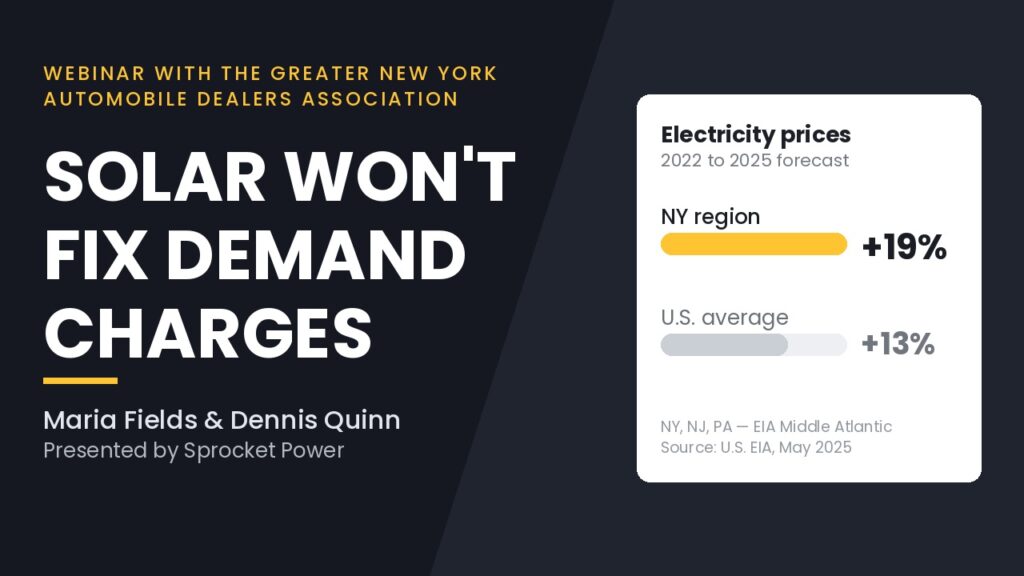
With utility costs increasing at rates higher than inflation, SMBs wishing to control their P&L are looking to approach energy costs with active management strategies. This is smart, and it starts with understanding the source of these costs. As business owners quickly learn, the drivers of rising utility bills are complex. In a utility bill that has grown by 50-80% over the last 5 years, which is typical, almost all of that growth comes from rising demand charges. This trend is expected to continue as utilities seek rate increases to support repair and build out of an aging grid. Electrification, including the addition of EV charging, will only add to this component of the utility bill.
If controlling costs = controlling demand, how? Traditional approaches like adding solar or negotiating a 3rd party supply contract will impact demand costs only marginally, if at all. Direct control of demand and demand charges can be achieved through a combination of hardware and software, but requires new and thoughtful approaches to succeed.
This is complex, but solvable: features to look for in regaining control
Developing and implementing these solutions is complex and is not, generally speaking, in the “wheelhouse” of most SMBs. But that doesn’t mean SMB owners should accept “business as usual” as these costs eat away at their bottom line. It is possible to gain control through approaches that incorporate critical components and experts capable of execution.
The same McKinsey article described two key goals businesses are looking to achieve through solutions: cost-effectiveness and predictability in energy costs. McKinsey lays out four features businesses require in such solutions:
- Include on-site assets: These approaches leverage the trend towards utility cost structures and grid markets rewarding facilities that reduce grid stress and provide grid resources. Businesses can move from being passive (if frustrated) consumers to being participants in the energy system, with the beneficial financial outcomes that follow.
- Seek integrated approaches: The integration of hardware and software into a managed system creates the strongest investment case. This can include the optimal combination of solar generation, battery storage, building management, and EV charger control into a total facility management system. Such a system, described as a microgrid, can cut utility bills by 50-90% – far more than any of these components in isolation.
- Engage technical experts: Businesses are recognizing that analyzing options and developing the business case for a chosen strategy requires specific expertise, especially in the interactions between on-site assets and the utility/grid cost and revenue structures. The benefits of such systems create a beneficial operating profile, but it is critical to access a party with the expertise to both design and run the system to ensure businesses “hit their numbers” underpinning the investment case. This is expertise not typically found in the vendors and advisors of most SMBs.
- Consider financing alternatives: Capital requirements and complexity are often roadblocks to beneficial solutions. Financing options should be an integral part of assessing the path forward. This can include arrangements that shift capital requirements and operating risk to expert 3rd parties aligned to create those benefits. Often referred to a Power Purchase Agreement (PPA), enables owners to preserve their capital and maintain focus on their core mission – running their business.
The good news is that integrating the approaches outlined above can produce solutions with a strong business and investment case (including payments of 4-6 years for direct investment). Finding the right partner to model, engineer, and implement is the key to achieving these results.
Sprocket Power has installed multiple microgrids and is a leader in innovative financing of sustainable energy solutions.
To discuss how our approach can help your business, contact:
Maria Fields at (914) 646-4016, mfields@sprocketpower.com, or
Ben Kriegler at (917) 363-0606, bkriegler@sprocketpower.com.