Sustainability Sells
Walk into any car dealership and you’ll see demonstrations of local community support. You might see it’s pictures of sponsored Little League baseball or CYO basketball teams, plaques recognizing staff participation in a local charity event, or awards acknowledging generous gifts to a good cause. Car dealerships have long understood the relationship between local community engagement and their bottom line.
Forward-thinking dealerships are recognizing that meaningful community engagement now includes adopting sustainability practices. They understand that reducing their carbon footprint and transitioning to sustainable sources of energy sends a strong positive message to the local community that is, in the long run, good for business.
A recent article in the Harvard Business Review, written by researchers from Deloitte Consulting LLP, identifies what they call a “major shift in consumption patterns” where consumers are considering brand commitment to sustainability as a prerequisite for buying. Their research highlights three factors driving this shift:
1) Trust drives behavior and, ultimately, business outcomes; 2) Sustainability promotes trust, particularly among younger generations; and 3) Younger generations will soon have most of the purchasing power in the U.S.
The researchers conclude that businesses that invest in sustainability will seize the advantage of their competition.
Invest In and Promote Sustainability
Simply selling electric vehicles isn’t enough to separate a car dealership from its competitors. To truly gain a competitive advantage and establish that “trust” with prospective buyers, a dealership will need to invest in renewable energy solutions.
For most dealers, investing in renewable energy means “going solar”, although solar alone does little to control demand charges. For dealers seeking to control their bottom line in the ERA of electrification, it means adopting a managed microgrid that integrates rooftop solar, battery storage, and management software into a system to directly control electricity use and costs.
But, to capture the emerging sustainability-conscious car buyer, dealers should incorporate their “green” credentials into their local marketing campaigns. Letting the buying public know that you are helping to preserve the environment is always a positive message and one that will, according to Deloitte research, bring customers to your door.
A Dealership with a Visible Sustainability Program
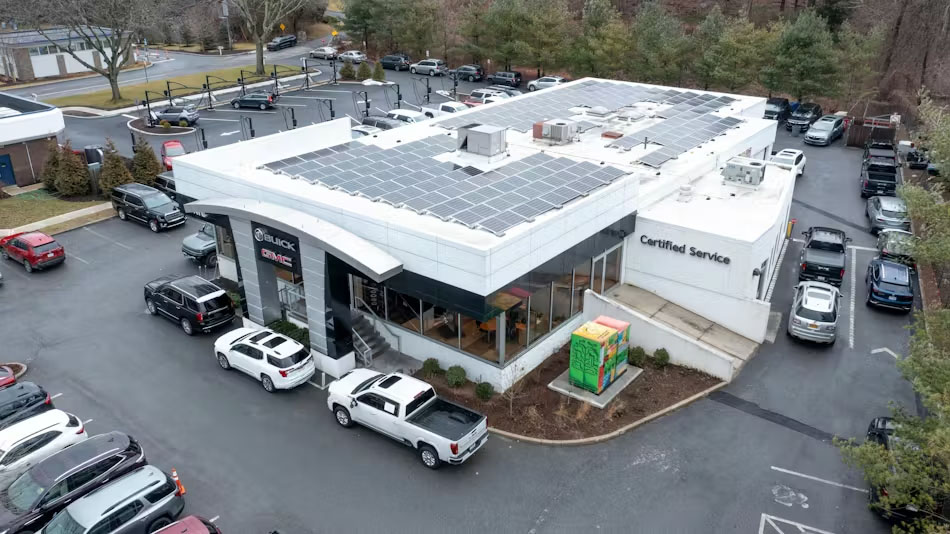
Vail Buick, a dealer in Westchester County, engaged Sprocket Power to engineer and install a managed microgrid at their facility. The project, completed in Q3 2023, included a 7,000 square foot rooftop solar array, 100 kW battery, utility service upgrade to 480 volts, and new Level 2 and 3 charging stations. Their new managed microgrid reduces their annual greenhouse gas emissions by 187 tons and will result in a 50% reduction in energy use and an 80% reduction in energy expense in year 5.
Driving down their utility costs and contributing to local GHG reduction goals wasn’t enough for Vail. They smartly elected to place their 100 kW battery near the entrance to their facility and engaged students from SUNY Purchase’s Community Design Program to design a brightly colored vinyl wrap that every visitor can’t help but notice. In other words, Vail is reaping all the benefits of going green, including promoting their commitment to sustainability to the local car-buying public.
Cox Automotive is forecasting that all-electric vehicles will account for over 10% of total vehicle sales in 2024 – compared to 7.6% last year. A recent survey by Escalent, a data analytics consulting firm and presenter at the 2024 NADA conference, reports that seven states have already reached the target threshold of 8% EV ownership*. There are several reasons underlying the upbeat sales projections, including: