
With much fanfare, New York City enacted the Climate Mobilization Act (CMA) in 2019. The legislation aims to reduce the city’s greenhouse gas (GHG) emissions by 40 percent by 2030. It’s hard to quibble with the goal, but building owners who don’t adapt their buildings to meet the demands of the CMA will have something to complain about – namely, hefty penalties in 2025.
The Challenge
The CMA consists of several local laws (LL) targeting specific areas of compliance: LL 84 applies to all buildings larger than 25,000 gross sq. ft. and requires building owners to report annual energy and water use to the city by May 1 of each year; LL 92 and LL 94 requires all new buildings and buildings undergoing major roof renovations to be covered with solar panels, a green roof, or some combination of the two; and, LL 97 applies to all buildings larger than 25,000 sq. ft., and requires each building to meet energy efficiency and GHG emissions limits starting in 2024.
LL 97 poses the greatest compliance risk to NYC dealers. Dealers operating from buildings larger than 25,000 sq. ft. must prepare to ensure compliance with the law.
a) How it Works
Building owners are responsible for self-reporting their GHG emissions each year – starting in May 2025 for energy used in 2024. GHG emissions are measured by the amount of electricity, direct steam, natural gas, and oil a building uses each year.
LL 97 pre-sets “emission factor multipliers” and “emission limits” for each energy type. The amount of energy used above the energy-specific emission limit is multiplied by $268 to determine a particular year’s penalty.
b) Sample Building
To keep it simple, let’s say a 25,000-square-foot-building, used entirely for retail, relies solely on electricity to light and heat the structure and used 1,500,000 kWh of electricity in 2024. LL 97’s electricity emission factor multiplier of .000288962 determines the building used 433.44 “tons of carbon dioxide equivalent per Kilowatt hour” (tCO2e/kWh). The emission limit for the building (25,000 x retail emission factor limit for electricity (.01181)) equals 295.25 tCO2e/kWh. The building is 138.19 tCO2e/kWh over the electricity emissions limit.
The sample building owner must pay a penalty of $37,034.92 (138.19 tCO2e/kWh x $268) for 2024.
The Solution
At the risk of stating the obvious, the way to avoid LL 97 penalties is to reduce your use of electricity, direct steam, natural gas, and oil so that you do not exceed the emission limits. Easy, right?
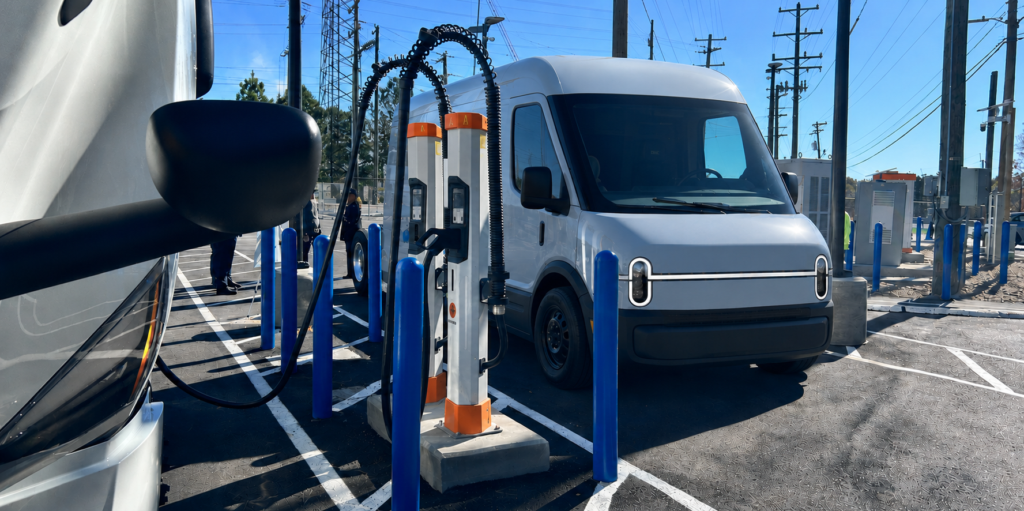
Wrong. In fact, it’s harder now than ever for dealers with on-site EV charging – they’re using more electricity, not less. The path forward is to reduce energy use through the installation of a managed microgrid (solar, battery storage, and energy use management software), plus taking advantage of utility programs that incentivize the use of electricity at off-peak times.
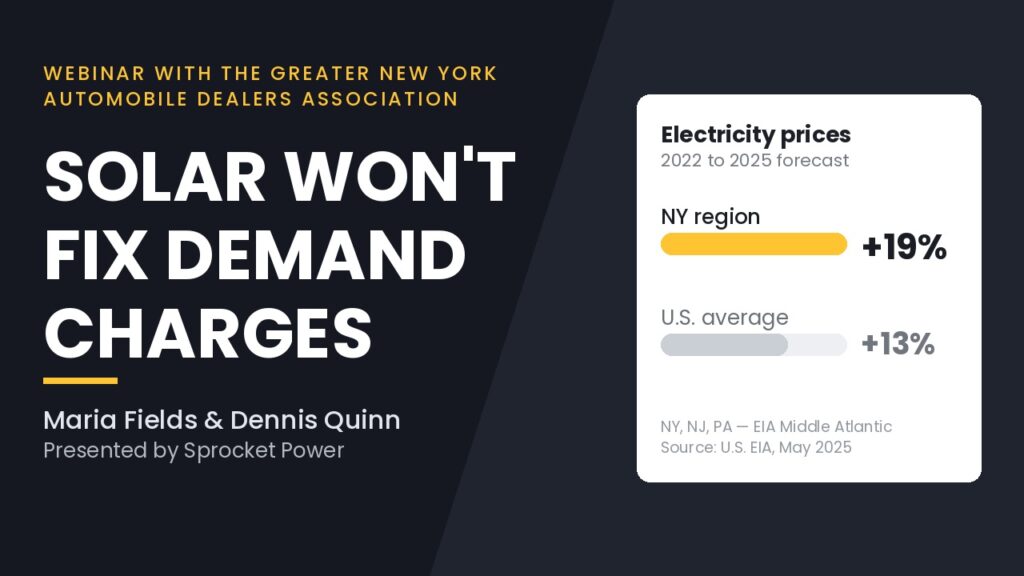
During a recent GNYADA webinar, representatives from Sprocket Power, Fisher Energy, and Con Edison discussed the impacts of the CMA on NYC dealers and Con Edison’s “SmartCharge Commercial” and “SmartCharge New York” programs. The webinar can be accessed by going to: https://www.gnyada-covid19.com/webinars-1/staying-ahead-of-nycs-climate-mobilization-act.